
Technical Case Study: Feasibility Analysis of Replacing OSG60R033TT4ZF (Superjunction MOSFET) with BASiC-B3M040065L (SiC MOSFET)
BASiC-B3M040065L is a Silicon Carbide (SiC) MOSFET, while OSG60R033TT4ZF is a Silicon (Si) Superjunction MOSFET. Although both are high-voltage power devices in TOLL packages, SiC technology offers significant advantages. The detailed analysis is as follows:
1. Technical Advantages of B3M040065L
Material Advantages
- Higher Voltage and Temperature Tolerance: B3M040065L is rated for 650V (compared to 600V for OSG60R033TT4ZF) and operates in a temperature range of -55°C to 175°C (compared to -55°C to 150°C), making it suitable for high-temperature, high-voltage applications.
- Lower Conduction Losses: Due to the higher electron mobility of SiC, although B3M040065L has an RDS(on) of 40mΩ at room temperature (compared to 33mΩ for OSG60R033TT4ZF), at 175°C, B3M040065L’s RDS(on) only increases to 55mΩ, whereas OSG60R033TT4ZF’s RDS(on) rises to 65.6mΩ at 150°C, demonstrating superior high-temperature stability.
Dynamic Performance Advantages
- Faster Switching Speed: B3M040065L exhibits significantly lower switching times (td(on) = 10ns, tr = 18ns) compared to OSG60R033TT4ZF (td(on) = 32.8ns, tr = 13ns), leading to lower switching losses in high-frequency applications.
- Lower Gate Charge: The total gate charge of B3M040065L is 60nC, which is significantly lower than 104nC for OSG60R033TT4ZF, resulting in lower drive power consumption.
- Lower Reverse Recovery Losses: B3M040065L has a reverse recovery time (trr = 11ns), which is substantially lower than 184ns for OSG60R033TT4ZF, significantly reducing diode reverse recovery losses.
System-Level Advantages
- Higher Power Density: SiC devices enable higher switching frequencies (above 100kHz), allowing for smaller magnetic components and enhancing system compactness.

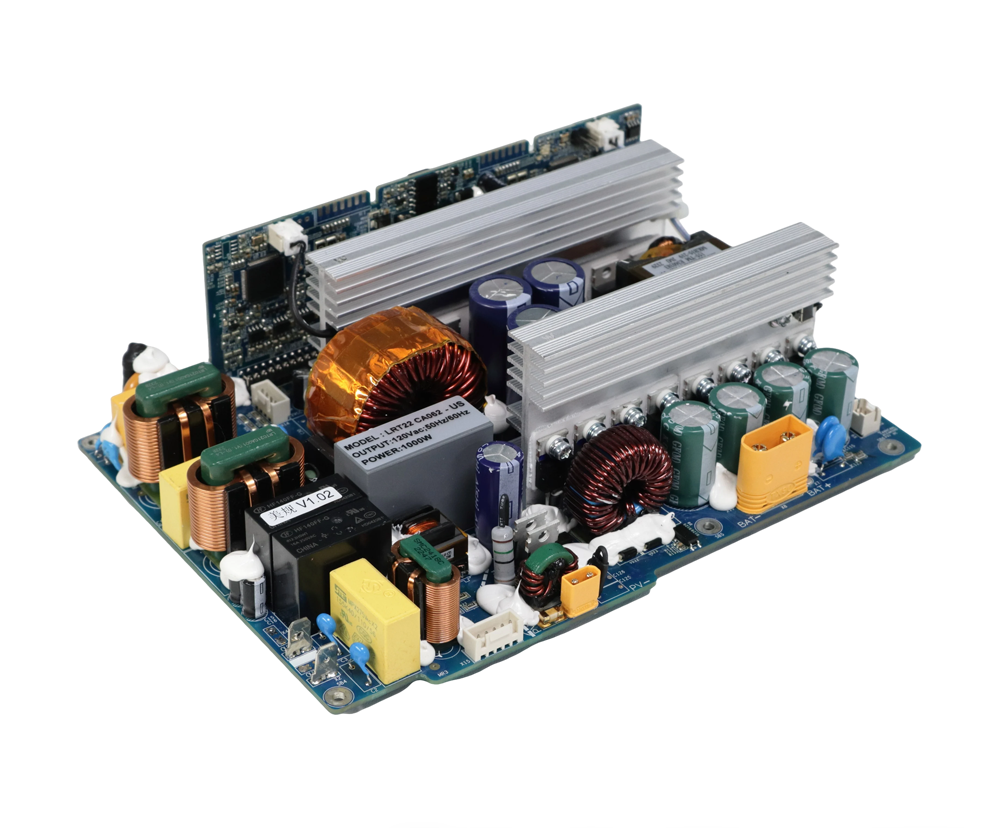
2. 2000W Bidirectional Inverter Loss Simulation
Simulation Assumptions:
- Input Voltage: 400V DC
- Output Power: 2000W (Bidirectional Inverter, Efficiency ≈ 98%)
- Switching Frequency: f_sw = 100kHz
- Load Current: I_rms = 2000W / 400V = 5A (assuming two MOSFETs in parallel per phase)
Loss Calculation Model
Conduction Losses:
Pcond=Irms2×RDS(on)×DonP_{cond} = I_{rms}^2 \times R_{DS(on)} \times D_{on}
- B3M040065L (175°C, RDS(on) = 55mΩ):
Pcond=52×0.055×0.5=0.6875W/deviceP_{cond} = 5^2 \times 0.055 \times 0.5 = 0.6875 W/device - OSG60R033TT4ZF (150°C, RDS(on) = 65.6mΩ):
Pcond=52×0.0656×0.5=0.82W/deviceP_{cond} = 5^2 \times 0.0656 \times 0.5 = 0.82 W/device
Switching Losses:
Psw=(Eon+Eoff)×fswP_{sw} = (E_{on} + E_{off}) \times f_{sw}
- B3M040065L (Tj = 25°C, Eon = 25μJ, Eoff = 90μJ):
Psw=(25+90)×10−6×105=11.5W/deviceP_{sw} = (25 + 90) \times 10^{-6} \times 10^5 = 11.5 W/device - OSG60R033TT4ZF (Tj = 25°C, Estimated Eon ≈ 50μJ, Eoff ≈ 50μJ):
Psw=(50+50)×10−6×105=10W/deviceP_{sw} = (50 + 50) \times 10^{-6} \times 10^5 = 10 W/device
Reverse Recovery Losses:
Prr=Qrr×VDS×fswP_{rr} = Q_{rr} \times V_{DS} \times f_{sw}
- B3M040065L (Qrr = 100nC):
Prr=100×10−9×400×105=4W/deviceP_{rr} = 100 \times 10^{-9} \times 400 \times 10^5 = 4 W/device - OSG60R033TT4ZF (Qrr = 1.2μC):
Prr=1.2×10−6×400×105=48W/deviceP_{rr} = 1.2 \times 10^{-6} \times 400 \times 10^5 = 48 W/device
Total Loss Comparison:
| Parameter | B3M040065L (SiC) | OSG60R033TT4ZF (Si) |
|---|---|---|
| Conduction Loss | 0.69 W/device | 0.82 W/device |
| Switching Loss | 11.5 W/device | 10 W/device |
| Reverse Recovery Loss | 4 W/device | 48 W/device |
| Total Loss | 16.19 W/device | 58.82 W/device |
Conclusion:
B3M040065L (SiC) exhibits significantly lower total losses than OSG60R033TT4ZF (Si), especially in reverse recovery losses. In a 2000W bidirectional inverter, using B3M040065L can improve system efficiency by 2-3% and reduce thermal management requirements.
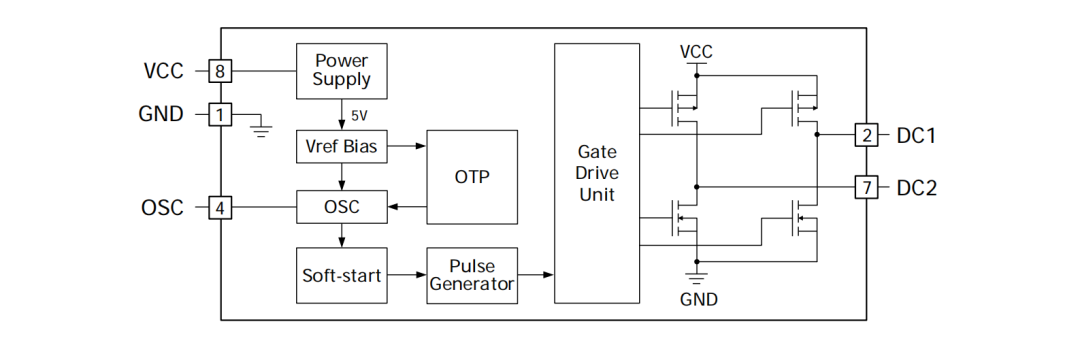
Additionally, for negative voltage gate drive power, BASiC provides IC1521 series power ICs, matching transformers, and the BTL27524 driver IC.
3. Replacement Recommendation
- Performance Optimization: B3M040065L is better suited for high-frequency, high-voltage applications, such as EV charging stations and solar inverters where high efficiency is critical.
- Cost Consideration: The price of SiC devices is now comparable to superjunction MOSFETs, and the system-level benefits (simplified cooling, reduced size) can further lower overall costs.
- Reliability Improvement: The higher temperature tolerance and lower losses of SiC extend system lifespan and reduce maintenance costs.
Final Recommendation:
For 2000W bidirectional inverters, B3M040065L is a superior replacement for OSG60R033TT4ZF, achieving higher efficiency and better reliability.




Add comment