Jinko 545W Monocrystalline Solar Panel
R510.00
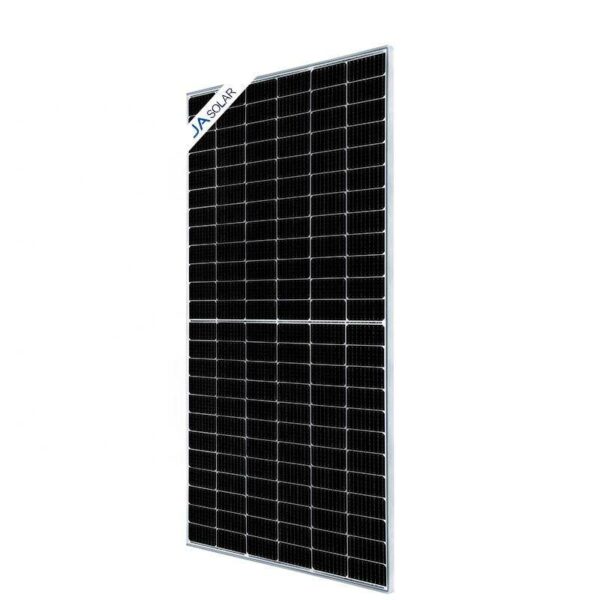
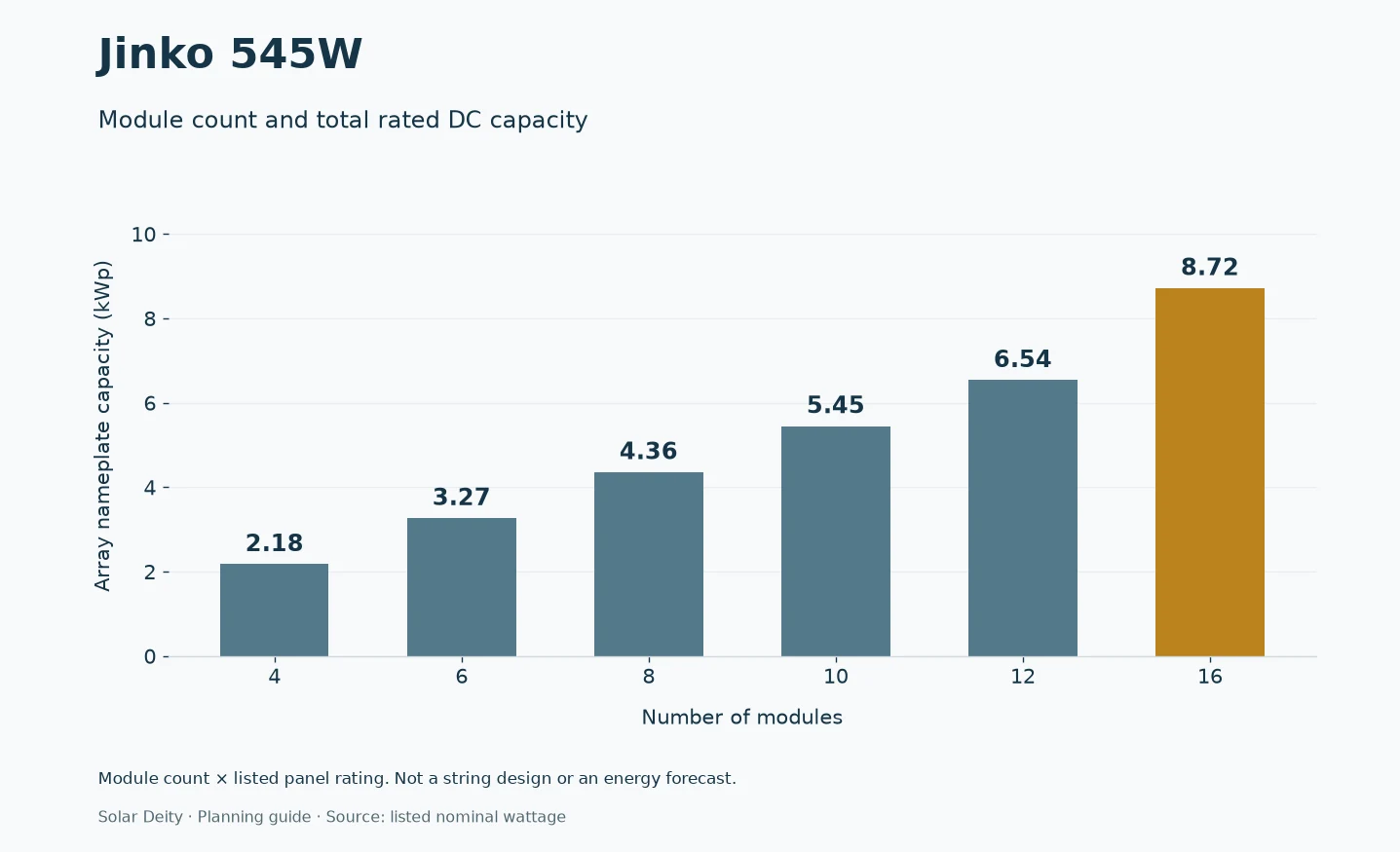
The Jinko 545W Monocrystalline Solar Panel is a 0.545kWp module option for a roof-mounted photovoltaic array. Ten panels provide 5.45kWp of nameplate DC capacity; twelve provide 6.54kWp. These figures make it easier to compare equipment quantities when planning a home, office or workshop system.
Jinko 545W Monocrystalline Solar Panel
The Jinko 545W Monocrystalline Solar Panel is a 0.545kWp module option for a roof-mounted photovoltaic array. Ten panels provide 5.45kWp of nameplate DC capacity; twelve provide 6.54kWp. These figures make it easier to compare equipment quantities when planning a home, office or workshop system. They describe the combined module rating, not a guaranteed inverter output or a daily electricity yield. The complete JKM model suffix has not yet been verified for this listing, so electrical connection limits and physical dimensions must be matched to the module offered in your quotation.
What the 545W rating means for your array
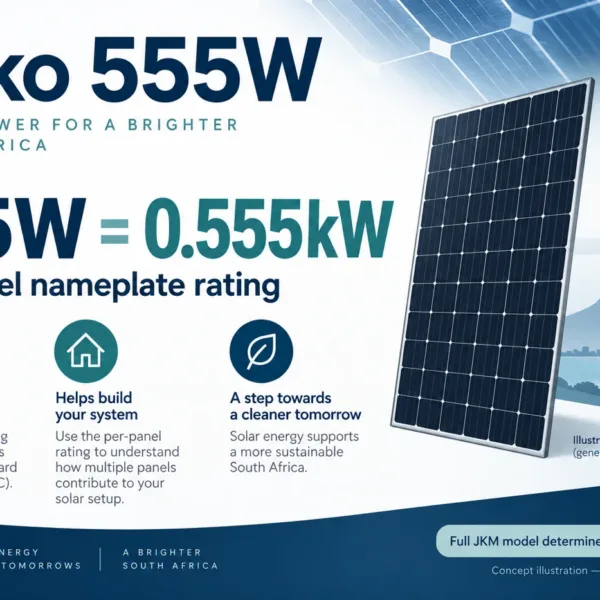
A 545W rating expresses maximum power under standard test conditions. It is useful for building a consistent equipment schedule: eight modules total 4.36kWp, ten total 5.45kWp and sixteen total 8.72kWp. In service, sunlight, cell temperature, shading and system losses all affect production. The rating therefore cannot promise 545W throughout the day. Comparing quotations by both module count and total DC capacity helps reveal whether two suppliers are actually proposing the same size installation.

Comparing 545W with nearby power classes
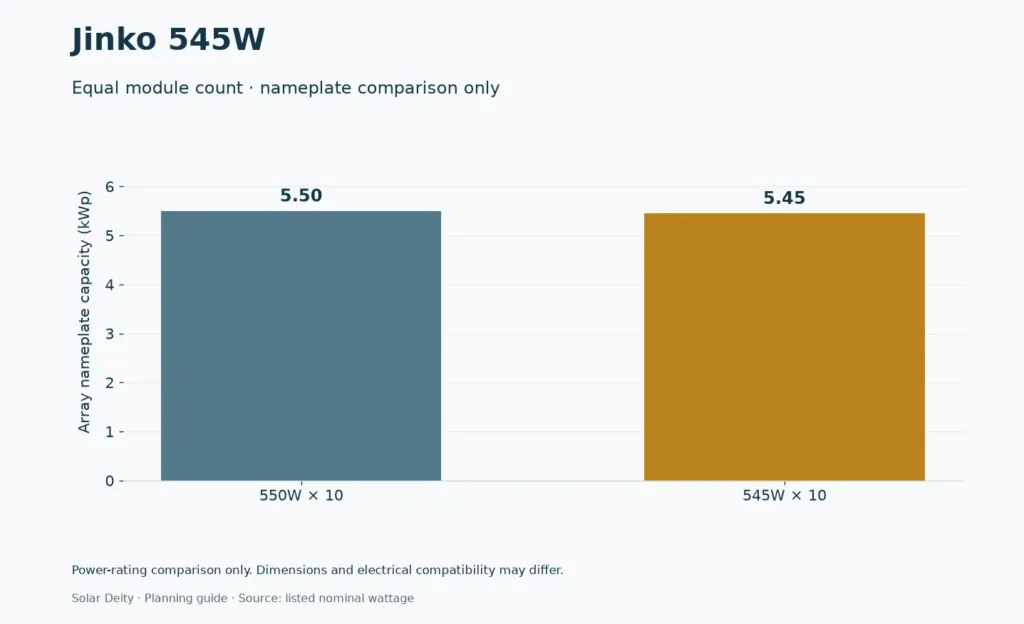
At the same count of ten modules, 545W panels total 5.45kWp and 550W panels total 5.50kWp. The difference is 0.05kWp, or about 0.92% of the 545W array rating. This small nameplate difference should be considered alongside the exact dimensions, electrical characteristics and commercial terms. It does not establish which module will produce more energy on your particular roof, and it does not make different models interchangeable within a string.
Planning an office or workshop installation
An office with computers, lighting and daytime activity may have useful demand during solar-producing hours. A workshop may instead have brief, high starting loads from machinery. These are different design problems even if each roof receives ten Jinko 545W panels. Record the daily operating schedule and the loads that must remain available during an outage. The panel array supplies energy; inverter output, battery capacity and the complete system configuration determine how that energy can support the connected equipment.
Using more than one roof orientation
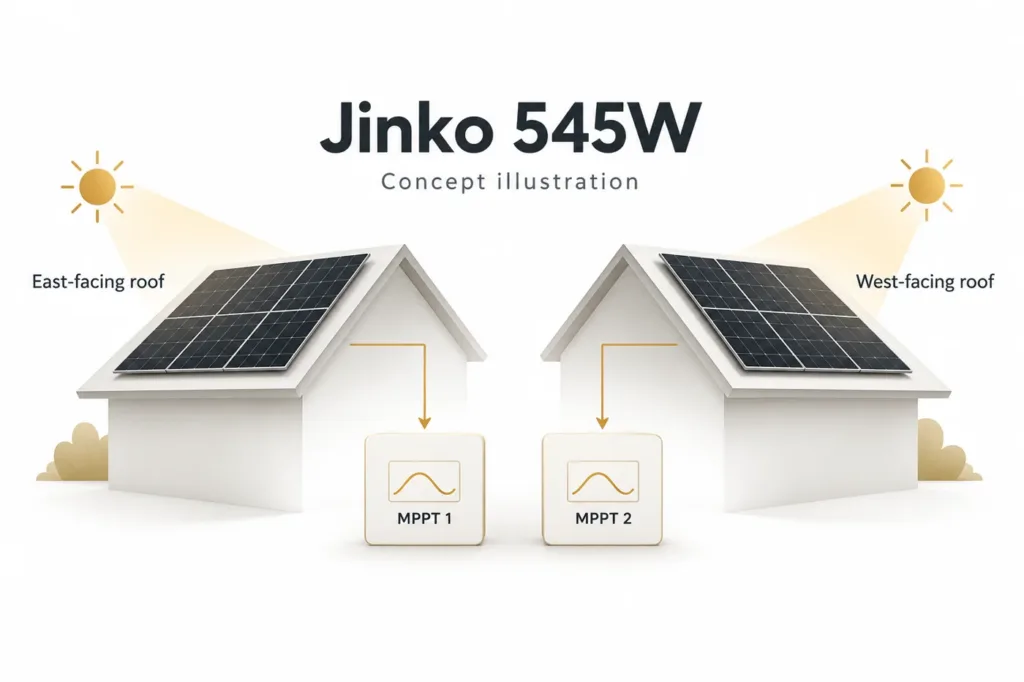
A building may have suitable roof areas facing different directions. Each area needs to be assessed for sunlight, obstructions and usable space before a panel quantity is chosen. Where groups experience different conditions, the installer should assess the inverter tracking arrangement using the actual module data. Our orientation illustration explains the planning idea only. It deliberately does not prescribe a string length or show a wiring design, because neither can be established from the 545W rating alone.
Selecting the inverter with the complete module data
For an inverter compatibility check, the important module values include open-circuit voltage, maximum-power voltage, short-circuit current and operating current. These must be read from the datasheet that matches the complete JKM code. The installer must also evaluate voltage across the intended temperature range and compare the proposed array with the inverter input limits. A 5kW inverter label by itself does not answer whether a 5.45kWp array is suitable or how its modules should be connected.
Understanding the planning illustrations
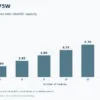
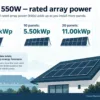
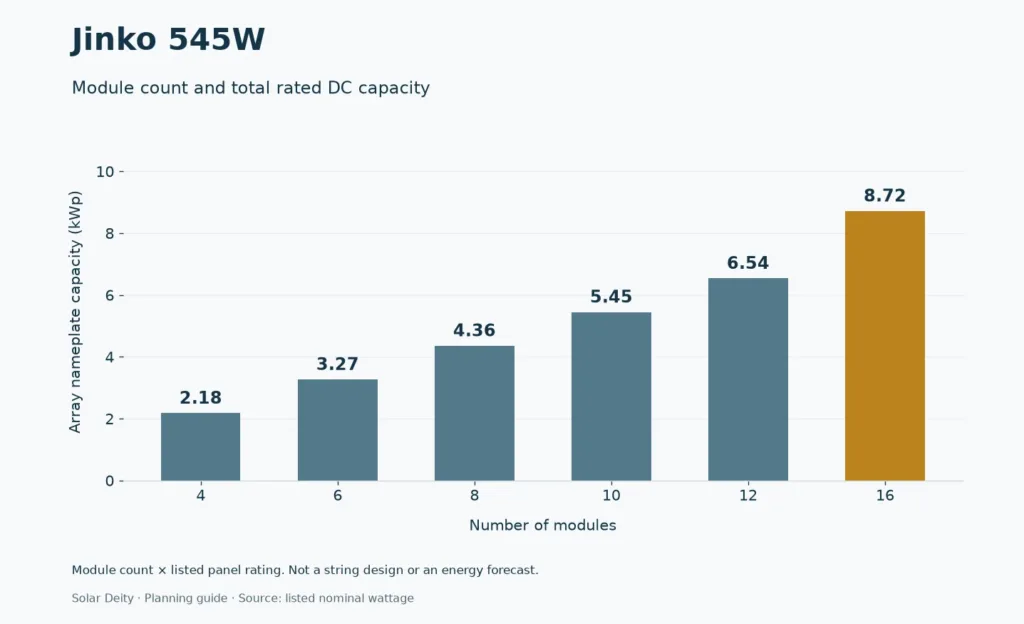
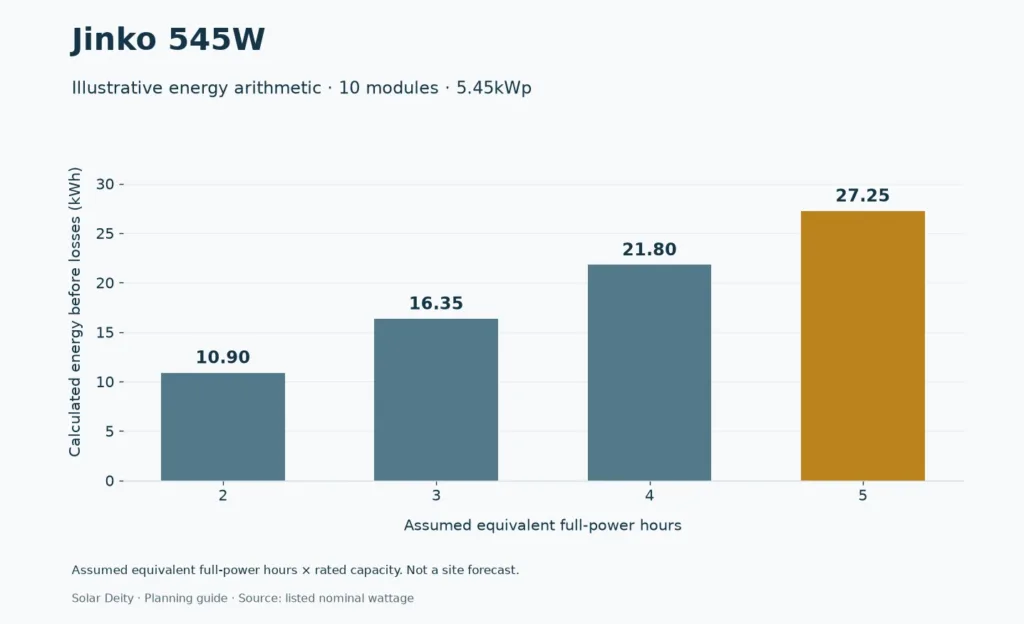
The capacity chart on this page uses module count multiplied by 0.545kW. The energy illustration uses an explicitly assumed number of equivalent full-power hours before losses; it is not a weather forecast or an installation simulation. The roof scene is a generated application concept. The equal-count comparison chart contrasts nominal 545W and 550W totals without implying equivalent dimensions. None of those illustrations replaces an exact product photograph, dimensional drawing or model-matched electrical datasheet.
Space, access and mounting considerations
Do not estimate roof fit from a perspective photograph. Ask for the offered module length, width, thickness and weight, then allow for the mounting system, access and site-specific setbacks in the layout. Existing roof condition and wind exposure also influence the installation plan. A larger nameplate rating does not necessarily mean a better fit for an awkward roof. A measured layout can be more useful than choosing the highest wattage before the available mounting area is understood.
Connecting solar generation with battery backup
This product is a solar module, not a complete backup system. A battery-equipped installation additionally needs a compatible inverter or charge controller and suitable protection, storage and installation equipment. During an outage, the ability to supply selected loads depends on how that complete system is configured. A panel array alone should not be described as an automatic backup supply. If backup is the main objective, share the essential loads and expected operating duration when requesting a system quotation.
Information to include in a quotation request
For this 545W option, send Solar Deity the required quantity, delivery location and intended inverter model. If there is an existing array, include its full module model rather than only its wattage. For a new roof, a measured layout and photographs of the roof surfaces help define the scope. Request the full JKM suffix, matching datasheet and applicable warranty documents before confirming the order. These details make the resulting proposal specific to the supplied equipment instead of a generic 545W description.
Before placing the order
Confirm whether the quotation is for modules only or includes mounting, electrical equipment and installation. Check delivery arrangements, the exact module identity and the quantity on the quote against your array schedule. Replacement stock should be assessed separately from a new uniform array. No particular efficiency, maximum system voltage, cell technology subtype or warranty duration is asserted here without the corresponding model documentation. The specification table keeps those unresolved items visible so that purchasing and design decisions do not depend on guessed values.
Product documentation
Technical specifications
| Parameter | Value / verification status |
|---|---|
| Brand | Jinko |
| Listed nominal maximum power | 545W (listing rating; exact model pending) |
| Listed module type | Monocrystalline solar module |
| Rated capacity per module | 0.545kWp (calculated) |
| 8-module array rating | 4.36kWp (calculated; not a string recommendation) |
| 10-module array rating | 5.45kWp (calculated) |
| 12-module array rating | 6.54kWp (calculated) |
| Full manufacturer model | Pending confirmation from the offered module label |
| Vmp / Imp / Voc / Isc | Pending exact model datasheet; not inferred from wattage |
| Efficiency / dimensions / weight | Pending exact model datasheet |
| Maximum system voltage / temperature coefficients | Pending exact model datasheet |
| Warranty terms | Confirm the applicable document for the supplied model |