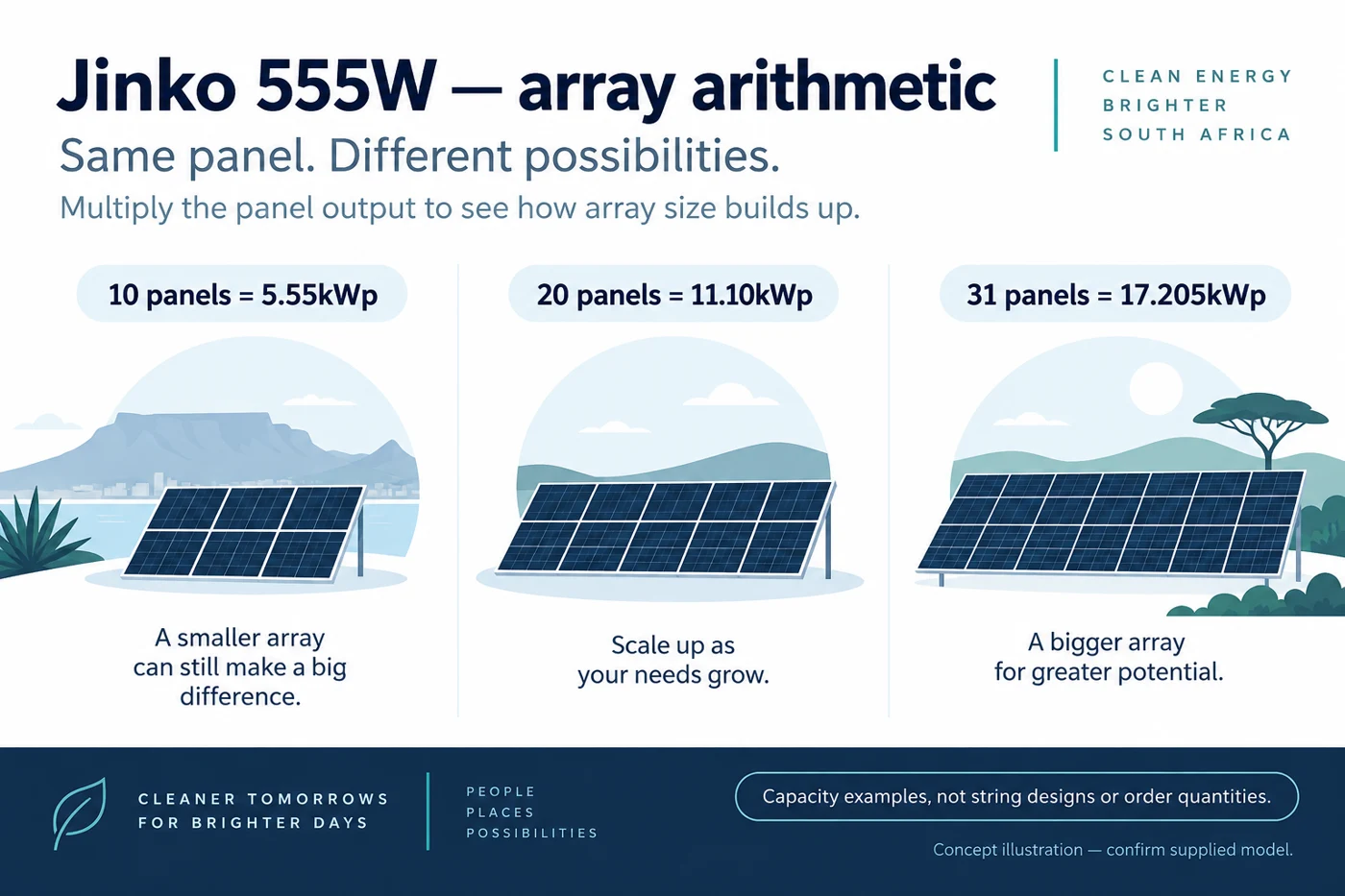
Jinko 555W Monocrystalline Solar Panel
R510.00
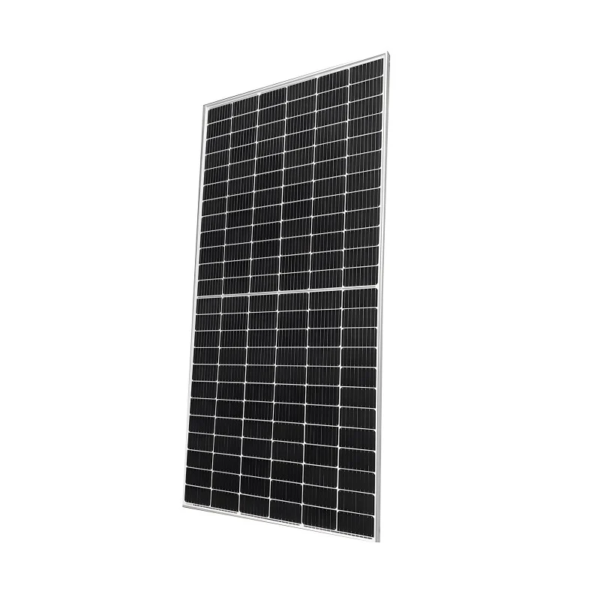
The Jinko 555W panel offer can be assessed for a multi-panel residential or commercial array by combining the per-panel rating with a defined site plan. Each listed module contributes 0.555kWp to the nameplate total. The project examples below explain quantity planning, delivery and inverter matching. They are not pre-approved string layouts, promised generation figures or confirmation that a particular pallet quantity is included in the displayed price.
Jinko 555W Monocrystalline Solar Panel
The Jinko 555W panel offer can be assessed for a multi-panel residential or commercial array by combining the per-panel rating with a defined site plan. Each listed module contributes 0.555kWp to the nameplate total. The project examples below explain quantity planning, delivery and inverter matching. They are not pre-approved string layouts, promised generation figures or confirmation that a particular pallet quantity is included in the displayed price.
Build a panel schedule before comparing project totals
A project schedule should name the full panel model and the number of modules assigned to each part of the array. This is more informative than a quotation that only states a total solar size. The same headline capacity can be assembled with different module counts and layouts. Start with the intended site use, then check how the proposed Jinko 555W modules fit the available area and inverter design.
Use nameplate arithmetic without turning it into a layout
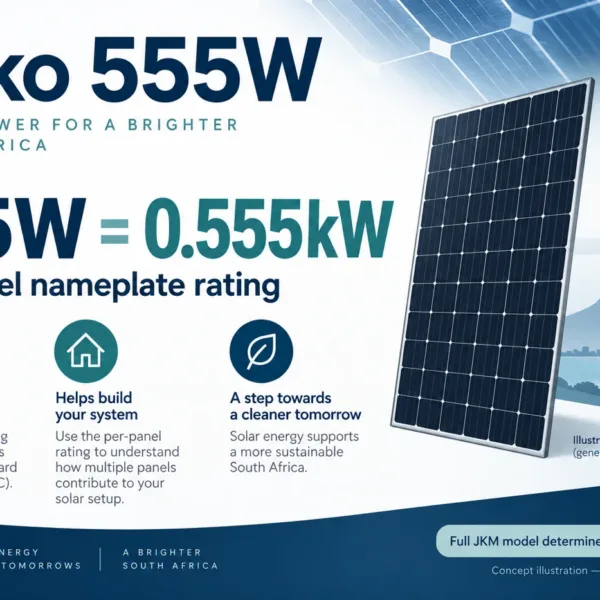
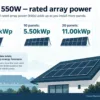
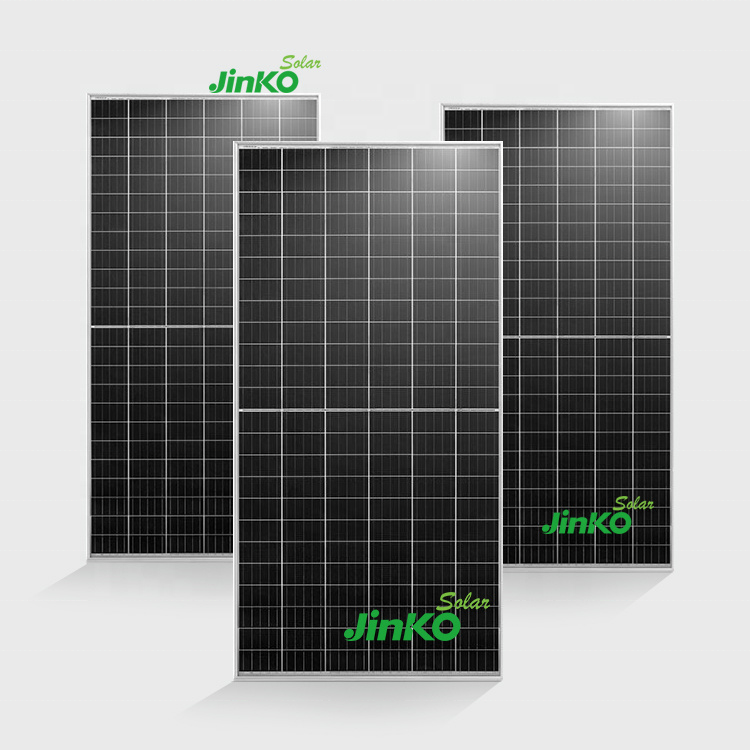
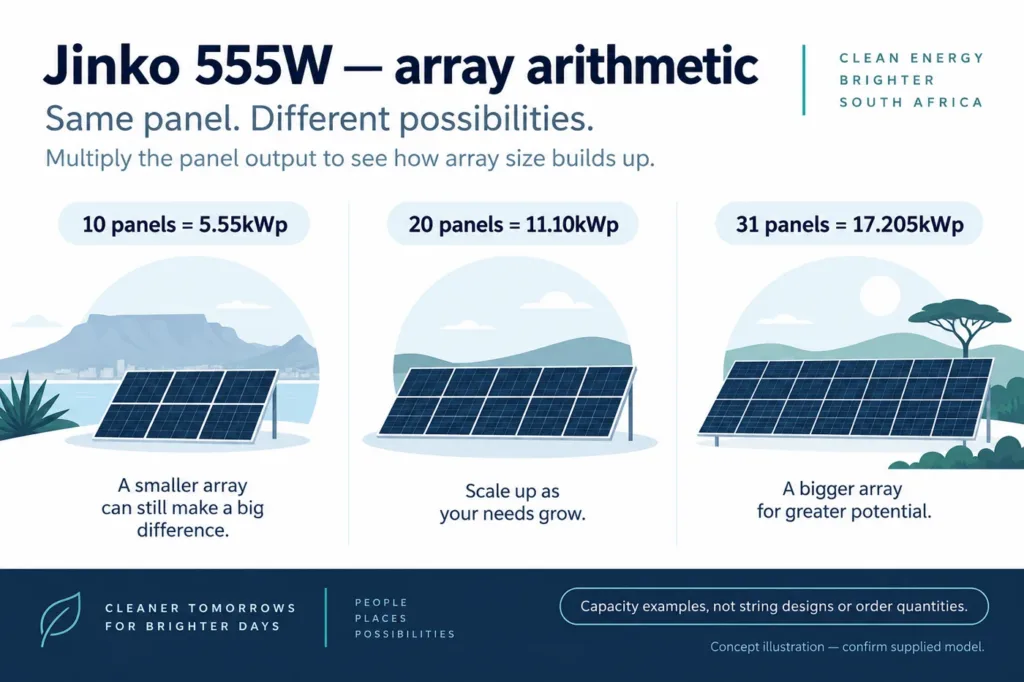
Ten 555W panels add to 5.55kWp, twenty to 11.10kWp and thirty-one to 17.205kWp. These calculations describe rated totals only. They do not mean those modules should be connected in one string or that the entire quantity belongs on a single tracker. The electrical designer must select the string arrangement using the exact module and inverter data. Keep the capacity calculation and connection design as separate steps.
The older pallet wording is not an order confirmation
A historical page address can contain a packing quantity even when the current offer needs a separate quotation. Confirm whether the displayed offer is priced per module, by a defined quantity or as a complete shipment. Ask for the number of panels, packaging arrangement and delivery terms in writing. The thirty-one-panel example here explains arithmetic and should not be interpreted as a promise that a pallet is included in a single purchase.
Allocate roof areas with different conditions deliberately
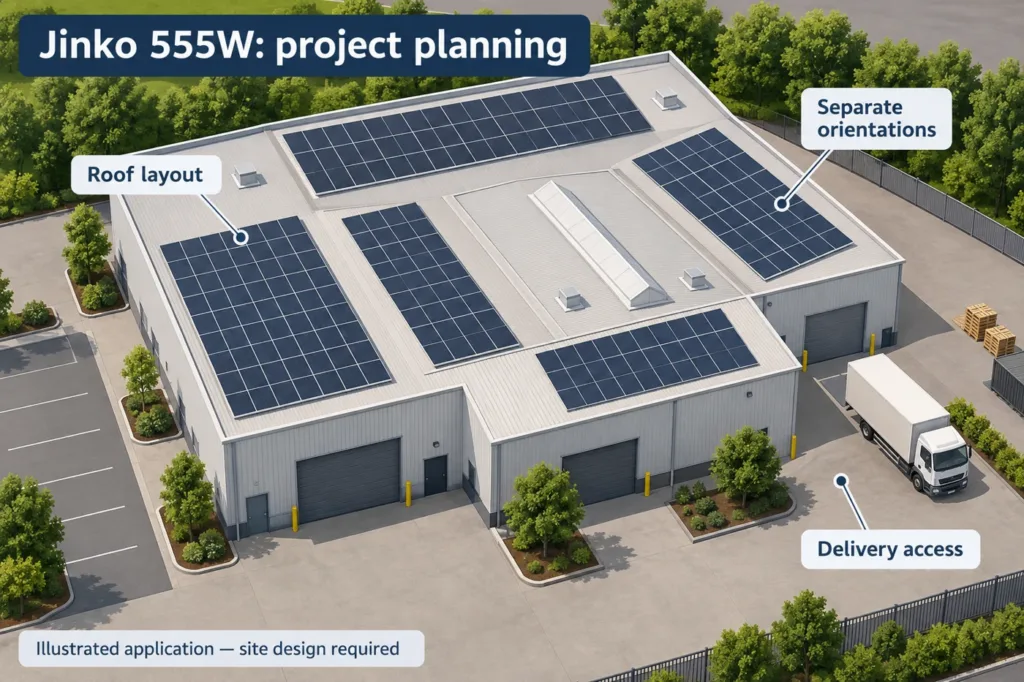
A roof may have sections facing different directions or affected by shade at different times. The illustrative warehouse layout makes those differences visible without declaring a final design. Supply the actual roof information to the installer so orientations, available area and obstructions can be assessed. The best arrangement is not established by filling every visible space in a drawing with another panel.
Connect the array plan to the operating schedule
For a business, a useful question is how generation may coincide with normal activity. A workshop operating during daylight and a building used mostly at night can value the same array differently. Compare expected production with the time electricity is consumed, including weekends and seasonal changes. The 555W rating helps calculate the nameplate size, while a site-specific assessment is needed to estimate energy use and financial results.
Ask for the exact JKM family before procurement
Jinko offers different module families, and 555W alone does not identify electrical ratings, dimensions or construction. The supplied model must be named before the project’s physical and electrical design is finalised. This avoids using one family’s specification sheet to justify another family’s product. It also makes delivery checks more straightforward because the order and the module label can be compared directly.
Assess current and voltage alongside total watts
The inverter’s permitted input conditions are as important as the rated array total. The proposed module’s operating and open-circuit values, current limits and temperature behaviour must be considered with the planned connections. Those model-specific figures are intentionally not guessed on this page. Request the matched panel datasheet with the project proposal so the designer can document the arrangement rather than relying on a wattage-only comparison.
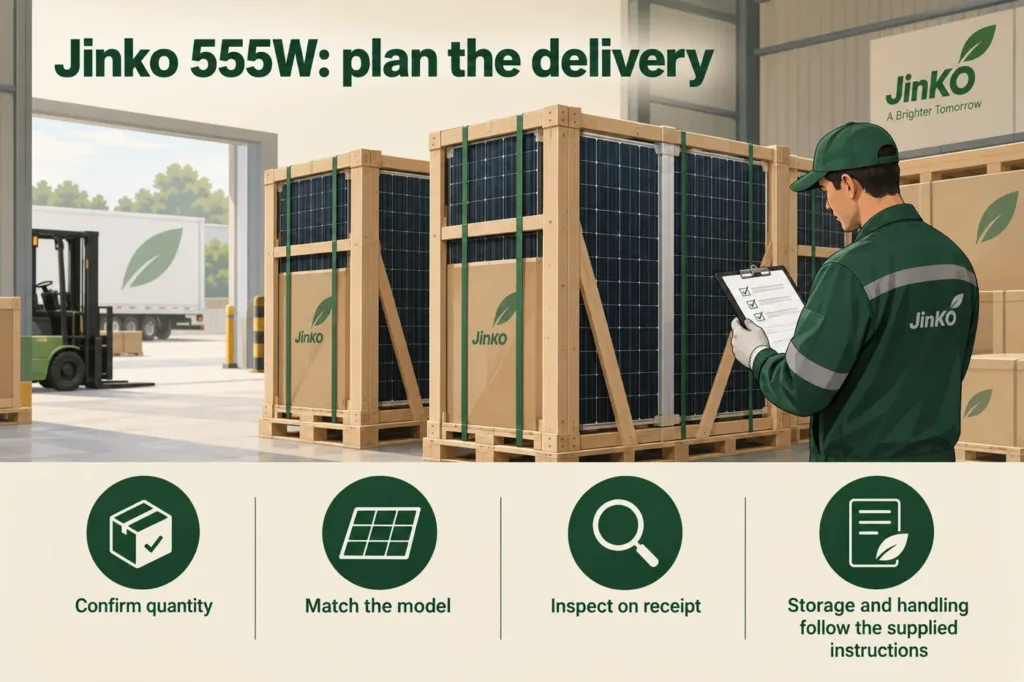
Plan receiving and storage before delivery day
A larger module order needs a suitable access route, receiving area and handling plan. Confirm the shipment details and coordinate inspection before the installation team needs the panels. Use the supplied manufacturer instructions for storage and handling. The delivery illustration identifies procurement tasks; it does not define a packaging method, lifting procedure or pallet count for the actual shipment.
Retain the product schedule through installation
Keep the ordered model, quantities and module identification records with the completed project documents. If an array spans several roof areas, the final documentation should make those groups understandable for later service. A future replacement or extension is easier to assess when the installed equipment can be identified precisely. This is a practical reason to resolve the full model code before procurement rather than after the modules have been mounted.
Request an array-specific offer
Provide the site location, intended panel quantity, inverter code, roof information and operating schedule. Ask Solar Deity to confirm the complete JKM555 model, sales quantity and delivery arrangement. The resulting proposal can then be compared on a consistent component basis. If the requirement changes, revise the panel schedule and electrical design together instead of assuming another few 555W modules can be added without review.
Manufacturer reference
Product family documentation. Match the supplied model and revision before applying installation limits.
Technical specifications
| Parameter | Product detail |
|---|---|
| Manufacturer brand | Jinko Solar |
| Catalogue module type | Monocrystalline solar panel |
| Module power class | 555 W / 0.555 kWp |
| Example: 10 panels | 5.55 kWp nameplate total |
| Example: 20 panels | 11.10 kWp nameplate total |
| Example: 31 panels | 17.205 kWp nameplate total |
| Order quantity and packaging | Confirm in the quotation; examples do not define the sale unit |
| Exact panel electrical data | Full JKM555 designation required |