Sunwoda SunESS Stackable Battery System
Original price was: R23,500.00.R18,000.00Current price is: R18,000.00.
Sunwoda SunESS is a stackable residential battery-system family built around manufacturer-described 5kWh modules. Its upright, integrated stack arrangement differs from an Atrix rack module. This page now separates the SunESS family reference from generic battery-room artwork and explains how module quantity affects a proposed system. Confirm the complete SunESS version and the number of modules included in your quotation before interpreting the total storage capacity.
Sunwoda SunESS Stackable Battery System
Sunwoda SunESS is a stackable residential battery-system family built around manufacturer-described 5kWh modules. Its upright, integrated stack arrangement differs from an Atrix rack module. This page now separates the SunESS family reference from generic battery-room artwork and explains how module quantity affects a proposed system. Confirm the complete SunESS version and the number of modules included in your quotation before interpreting the total storage capacity.
Choose a configuration rather than a photograph
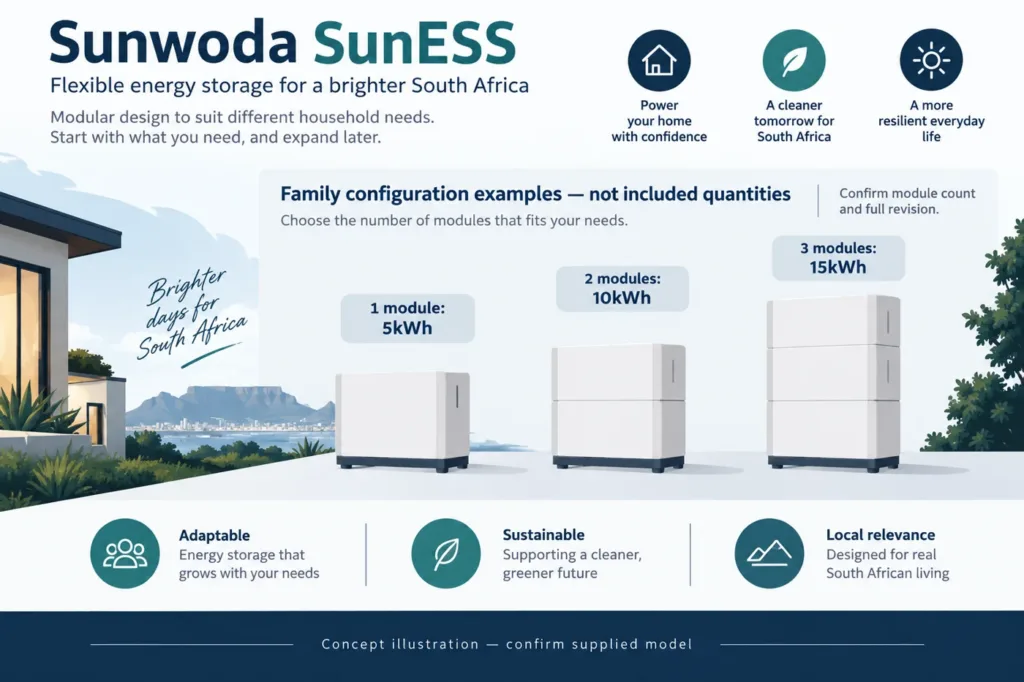
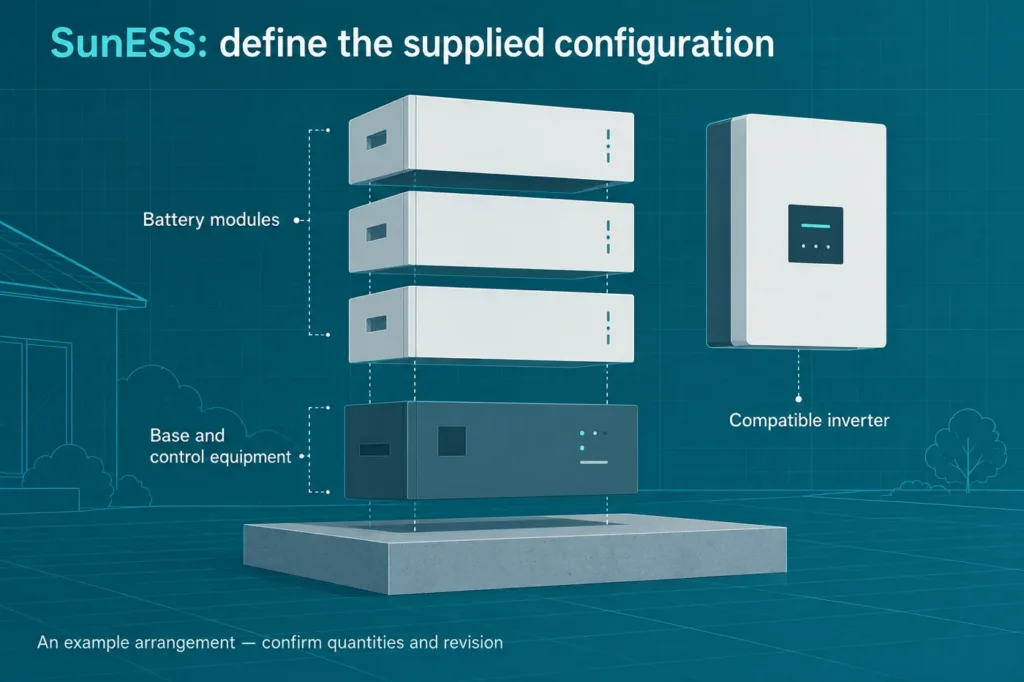
An image of a tall stack can be mistaken for the exact battery quantity included in the advertised offer. SunESS family images show how modular storage can be arranged; the written component schedule defines the supply. Check the number of battery modules, the base and any control or connection equipment. If you are comparing two offers, compare these lists before assuming that similar-looking stacks contain the same storage.
Calculate nominal energy from the documented modules
For the referenced 5kWh platform, two modules correspond to 10kWh and three to 15kWh of nominal family capacity. These are configuration examples, not the quantities promised by this listing. Actual usable energy has its own test conditions and operating constraints. Do not use the older wording embedded in the page address as a specification; the confirmed module schedule and matching documentation determine the delivered system.
Stack height and electrical voltage are different questions
Adding visible sections to a battery tower does not, by itself, establish a different operating voltage. The SunESS family reference identifies 51.2V nominal operation, while system capacity depends on the supported module arrangement. Do not apply high-voltage battery design assumptions merely because the enclosure is tall. The installer should match the exact SunESS revision to the inverter and verify the permitted connection and control arrangement.
Use the SunESS family image to identify the format
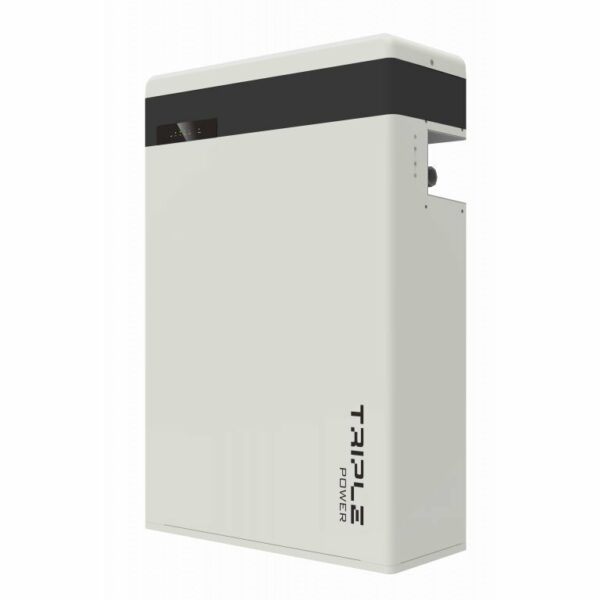
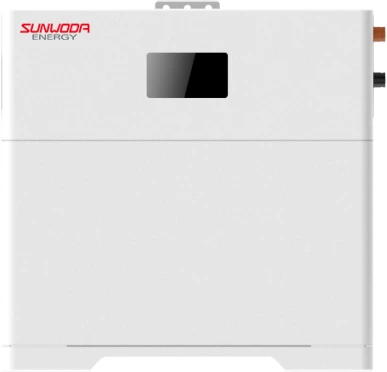
The manufacturer reference on this page shows the upright SunESS-5 enclosure format. It is a family reference rather than confirmation of the complete configuration included in this offer. Use it to understand the general arrangement, then match the delivered model and component list to the quotation. The supplied revision, base and module count determine the actual storage system, its installation requirements and its documented operating limits.
Define an evening energy requirement
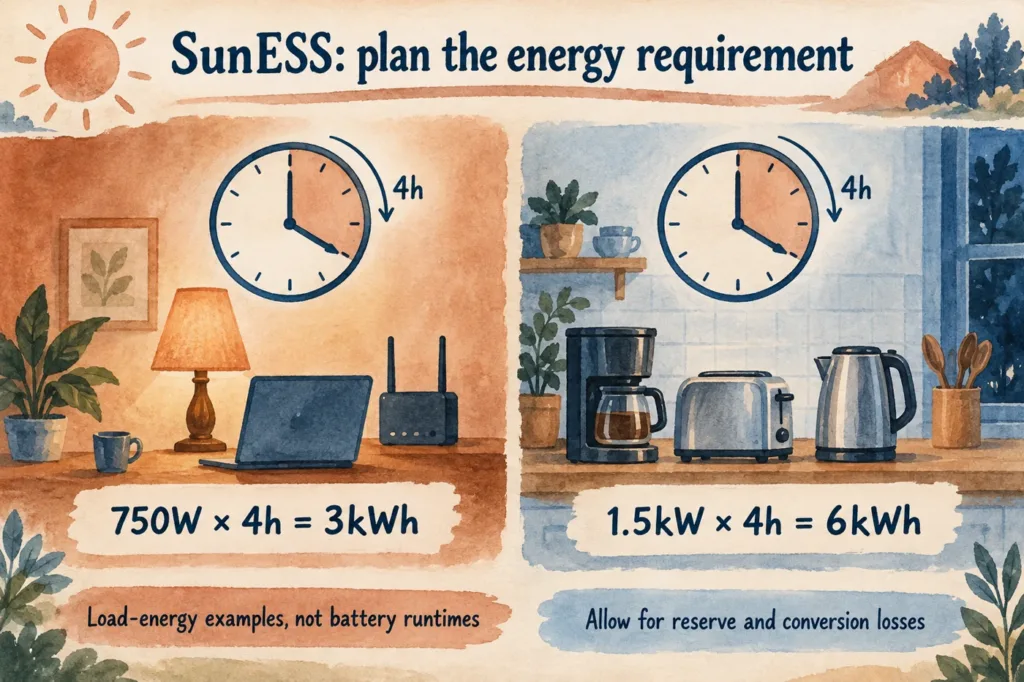
A home using an average of 750W for four evening hours requires 3kWh at the loads. If the average becomes 1.5kW, the same period needs 6kWh. These demand calculations help frame a storage discussion without claiming a fixed SunESS runtime. The selected system also needs allowance for operating reserves and conversion losses. Recording actual consumption gives a more useful starting point than counting rooms or household occupants.
Account for demand that occurs together
The number of stored kilowatt-hours does not determine whether all appliances can run simultaneously. Cooking equipment, pumps and other larger loads can create power requirements that need a separate assessment. The battery configuration and inverter must both support the intended demand. Ask for the sustained output available from the proposed system, including any operating restrictions, rather than assuming a larger stack removes every limitation.
Confirm communication support before commissioning
The SunESS documentation identifies CAN and RS485 interfaces at family level. Compatibility still depends on the inverter code, battery revision and supported communication arrangement. Share details of existing equipment that will remain connected. A successful physical connection is only one part of commissioning; the system also needs to exchange the information required for appropriate operation. Use the installer’s matched instructions instead of copying settings from a different Sunwoda family.
Allow space for the completed stack
Reserve the area needed by the entire proposed configuration, including the base, access and manufacturer-required clearances. A drawing of one module is not a complete footprint or handling plan for several modules. The installation location and enclosure protection must be checked for the supplied revision because published SunESS versions differ. The illustrations are useful for discussing layout, but they are not permission to expose any battery to unsuitable conditions.
Plan future capacity with today’s configuration recorded
A modular product can make staged storage planning attractive, but later additions remain subject to the supported expansion procedure. Keep the initial module and control-equipment details, along with the commissioning record. Before expanding, have compatibility, condition and the proposed arrangement assessed. This prevents an assumption that any future SunESS-labelled module can simply be added to an older stack without checking the documentation.
Compare complete storage proposals
For a useful quotation, provide the inverter model, intended module quantity, essential demand and the available installation space. Clarify whether the offer includes the base, control equipment, connection components and installation. Also state whether your main objective is evening solar use, interruption support or a combination. A defined SunESS configuration can then be assessed on its documented capacity and operating limits rather than on the height of its product picture.
Manufacturer reference
Product family documentation. Match the supplied model and revision before applying installation limits.
Sunwoda SunESS family and product-image reference.
Technical specifications
| Parameter | Product detail |
|---|---|
| Product family | Sunwoda SunESS stackable residential storage |
| Manufacturer module energy reference | 5 kWh |
| Manufacturer nominal voltage reference | 51.2 V |
| Example with two modules | 10 kWh nominal family configuration |
| Example with three modules | 15 kWh nominal family configuration |
| Communication family reference | CAN 2.0 / RS485 |
| Supplied quantity | Confirm module count, base and control equipment |
| Version-specific limits | Confirm current, enclosure rating, dimensions and supported expansion |