Jinko 415W Monocrystalline Solar Panel
R510.00
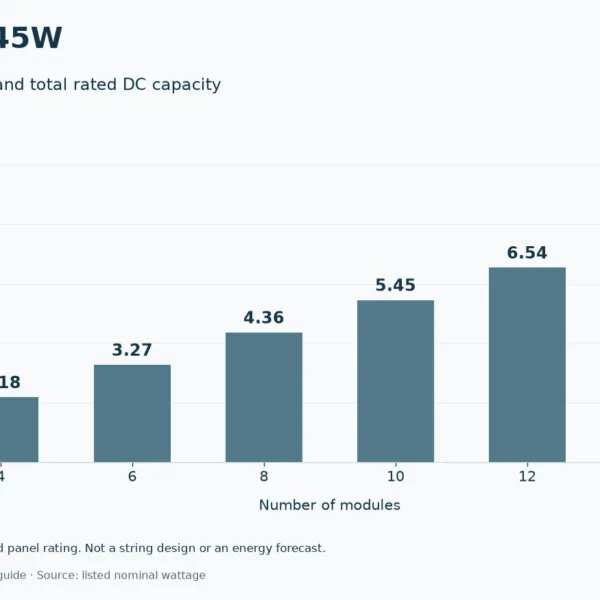
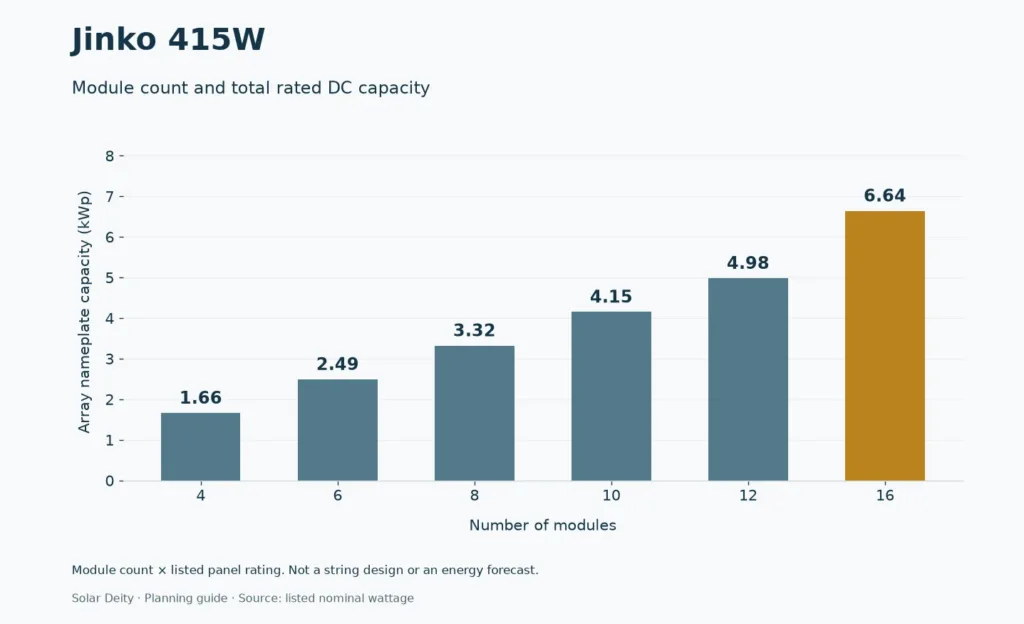
The Jinko 415W Monocrystalline Solar Panel is listed with a nominal power rating of 415W, equivalent to 0.415kWp per module. Eight units total 3.32kWp and ten total 4.15kWp. This can be a useful power class to consider when preparing a new array schedule or investigating replacement equipment for an existing installation.
Jinko 415W Monocrystalline Solar Panel
The Jinko 415W Monocrystalline Solar Panel is listed with a nominal power rating of 415W, equivalent to 0.415kWp per module. Eight units total 3.32kWp and ten total 4.15kWp. This can be a useful power class to consider when preparing a new array schedule or investigating replacement equipment for an existing installation. Replacement suitability requires considerably more than a matching wattage, however. The complete JKM model for the stock offered under this listing must be confirmed before electrical and physical compatibility can be established.
A practical capacity reference
Four modules total 1.66kWp, six total 2.49kWp, eight total 3.32kWp and twelve total 4.98kWp. These totals are calculated from the listing rating and help compare module quantities without rounding the product up to a different power class. They do not determine a suitable inverter connection or the size of a battery. For a new installation, use the totals alongside a measured layout and a complete equipment design rather than treating panel count as the only decision.
Replacing a panel in an existing array
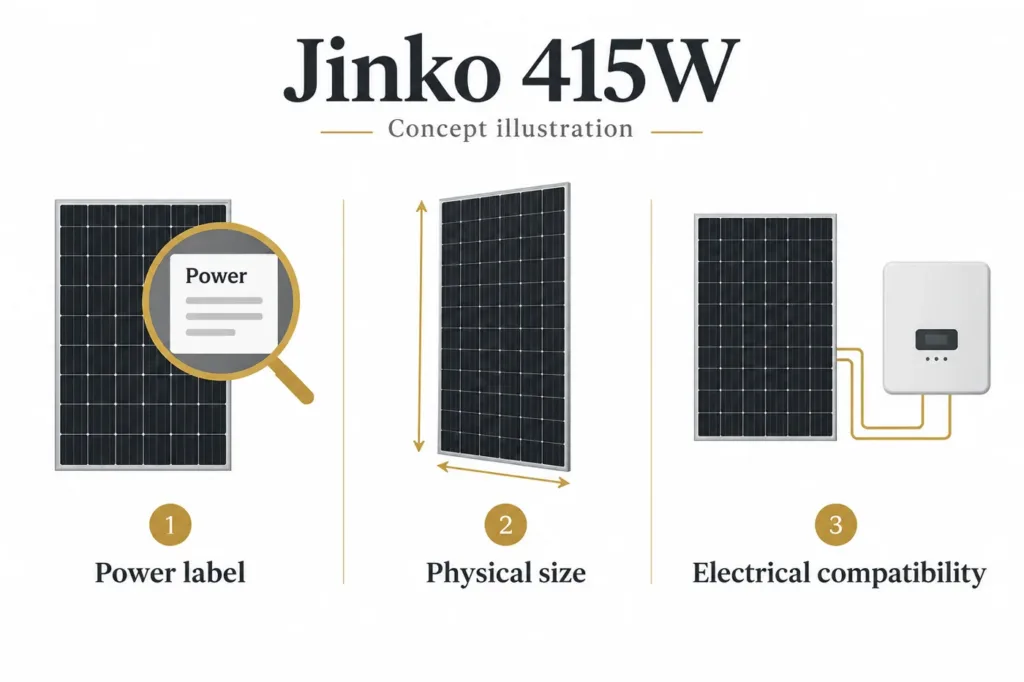
A replacement enquiry should include the full model of the original panel, clear label photographs and the original system arrangement where available. Two modules marked 415W may have different voltage, current, dimensions or connector arrangements. A close visual resemblance is also insufficient evidence of compatibility. Have the installer evaluate the actual replacement against the existing array. This listing should therefore be used to request identification and documentation, not as a promise that any Jinko 415W unit can replace another.
Mechanical fit is separate from rated power
A panel may have the desired wattage but still be unsuitable for the existing mounting layout. Length, width, frame thickness, weight and the manufacturer-approved mounting requirements all matter. The product photograph is useful for a general view, but it is not a scale drawing and cannot establish mounting compatibility. Before a replacement is delivered to site, compare the dimensional information with the roof and mounting equipment. Those checks can prevent an apparently simple replacement from becoming an unplanned alteration.
Electrical matching needs the exact datasheet
The complete JKM code identifies the relevant electrical data more reliably than a short product title. Open-circuit voltage, operating voltage, short-circuit current and operating current are separate values with different roles in system design. The proposed arrangement must be checked against the inverter input limits and expected temperatures. None of those numbers is derived here by dividing 415W by an assumed voltage. That would create a plausible-looking specification without evidence that it describes the supplied module.
Comparing eight-panel options
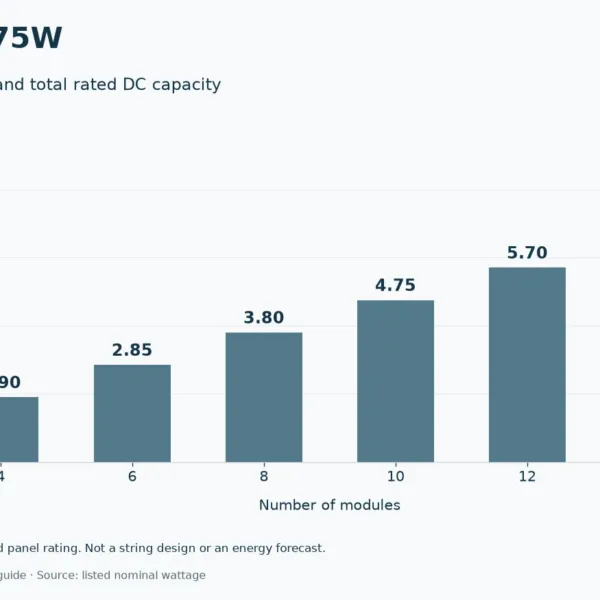
Eight 415W panels total 3.32kWp, while eight 475W panels total 3.80kWp. The 0.48kWp difference is a nameplate comparison, not a recommendation to exchange one for the other. The higher-power option may have different dimensions or electrical behaviour, and the existing equipment may constrain the choice. For a new array, compare complete quotations with verified layouts. For repairs, compatibility and the installer assessment take priority over selecting the larger wattage shown in a catalogue.
A compact-roof application concept
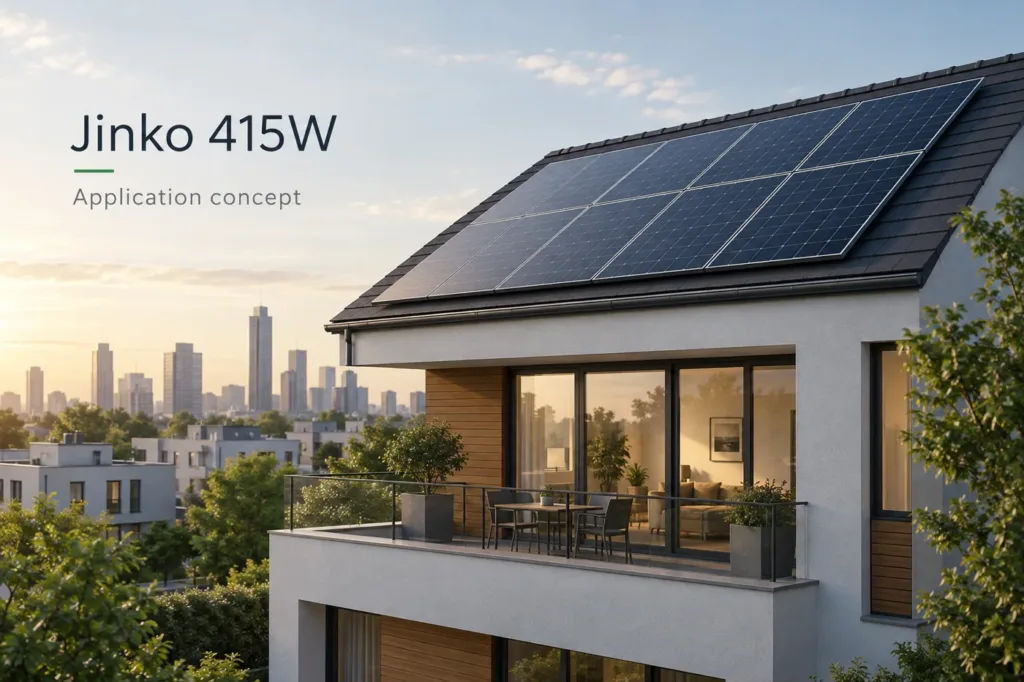
The illustration on this page shows a small urban roof as a possible planning context. It does not assert that the 415W module has a particular compact dimension or will fit a pictured roof. Its purpose is to make clear that usable roof space and access need attention in smaller installations. Actual module dimensions remain to be confirmed. A measured plan, obstruction assessment and correct mounting design are necessary before translating an attractive concept image into an equipment order.
Reading the energy example correctly
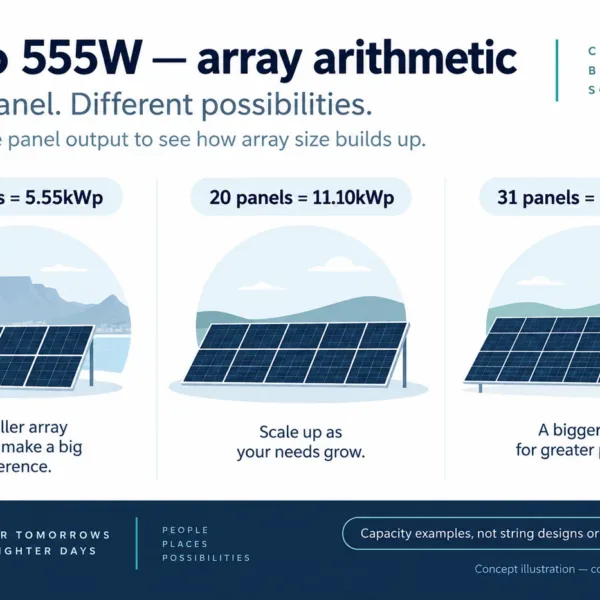
For a ten-panel array rated at 4.15kWp, four assumed equivalent full-power hours correspond to 16.60kWh before losses. This is a worked multiplication example only. Actual energy changes with location, orientation, shading, temperature and the complete system. The chart does not calculate a household backup duration, because that also depends on storage and load demand. Keeping these quantities separate avoids confusing the instantaneous power rating of a panel with the energy available over a day or from a battery.

Documentation to keep with the system
Record the full module model, serial identification and applicable datasheet when equipment is supplied. Keep those records with the invoice and installation documentation so they are available for maintenance or a future replacement enquiry. A saved product-page title alone may not identify the exact batch or variant. Where the original model is no longer available, documented specifications allow a qualified installer to assess alternatives more carefully than a brand-and-wattage search can.
What is included in the enquiry
Tell Solar Deity whether this is a new installation, an extension or a repair. Provide the required quantity, delivery location and inverter identification. A repair request should also include the original panel label and mounting details. Ask for written confirmation of the offered JKM model, electrical datasheet and applicable warranty terms. The price and stock information shown in the purchasing section remain separate from this technical guide and should be checked against the final quotation.
Product image and specification boundaries
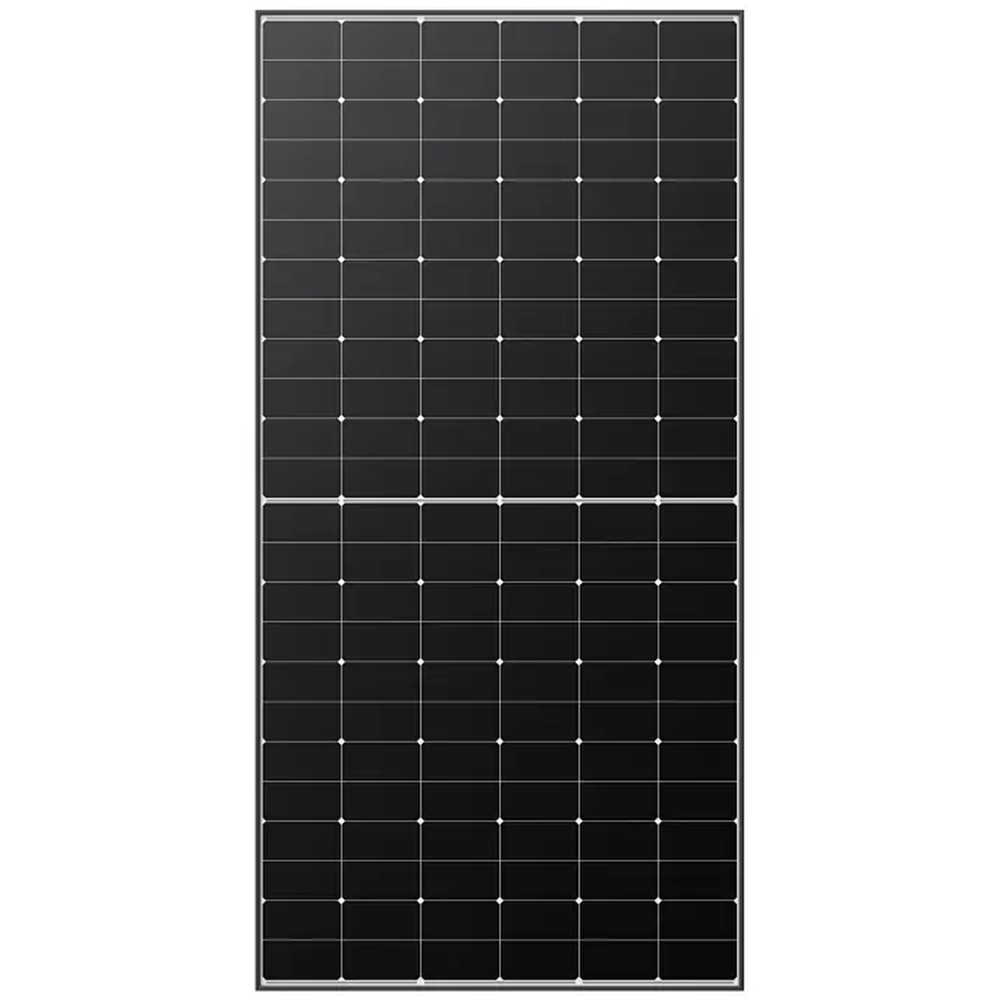
The existing 415W listing photograph is retained as the product view. Additional illustrations explain the application and the separate checks involved in selection; they are not manufacturer photographs or installation instructions. No unsupported claim is made for efficiency, cell technology subtype, panel size or service life. The specification table identifies which information comes from the listing and which still needs model confirmation. That distinction is especially important on a replacement-oriented enquiry, where a guessed value can be more misleading than an explicitly unresolved one.
Product documentation
Technical specifications
| Parameter | Value / verification status |
|---|---|
| Brand | Jinko |
| Listed nominal maximum power | 415W (listing rating; exact model pending) |
| Listed module type | Monocrystalline solar module |
| Rated capacity per module | 0.415kWp (calculated) |
| 8-module array rating | 3.32kWp (calculated; not a string recommendation) |
| 10-module array rating | 4.15kWp (calculated) |
| 12-module array rating | 4.98kWp (calculated) |
| Full manufacturer model | Pending confirmation from the offered module label |
| Vmp / Imp / Voc / Isc | Pending exact model datasheet; not inferred from wattage |
| Efficiency / dimensions / weight | Pending exact model datasheet |
| Maximum system voltage / temperature coefficients | Pending exact model datasheet |
| Warranty terms | Confirm the applicable document for the supplied model |